Why AI Agents Need Traditional ML to Win in 2026 - The Hybrid Advantage
Content
- Overview
- Visualize the New AI Architecture
- The Anatomy of an Agent’s Decision
- Why Enterprises Stick with the “Boring” Math
- Conclusion: Hire a Team, Not just a Genius
- Credits
Overview
We’ve all seen the headlines. LLMs (Large Language Models) like Gemini and Claude are rewriting the rulebook of intelligence. They write poetry, debug code, and summarize thousands of documents in seconds.
And now, the narrative is shifting again: the era of AI Agents has arrived. These are not just models; they are workers—autonomous entities that can take actions, use APIs, and make decisions to achieve a goal.
With all this firepower, the question echoes across enterprise hallways and developer forums:
“Are classification, regression, and forecasting officially dead? Did the traditional Machine Learning engineer just become obsolete?”
It’s a reasonable assumption. If you have an Agent that can “think,” why would you need a humble Random Forest model?
But the assumption is wrong. In 2026, the truth is far more interesting. Traditional ML isn’t dying; it’s getting a promotion to “Specialist Status”.
Let’s visualize exactly how these two worlds collide and cooperate.
Visualize the New AI Architecture
To understand the modern AI ecosystem, we have to stop thinking about replacement and start thinking about integration. The industry is not moving to a single, monolithic “brain.” Instead, we are building ecosystems where different types of intelligence handle different tasks.
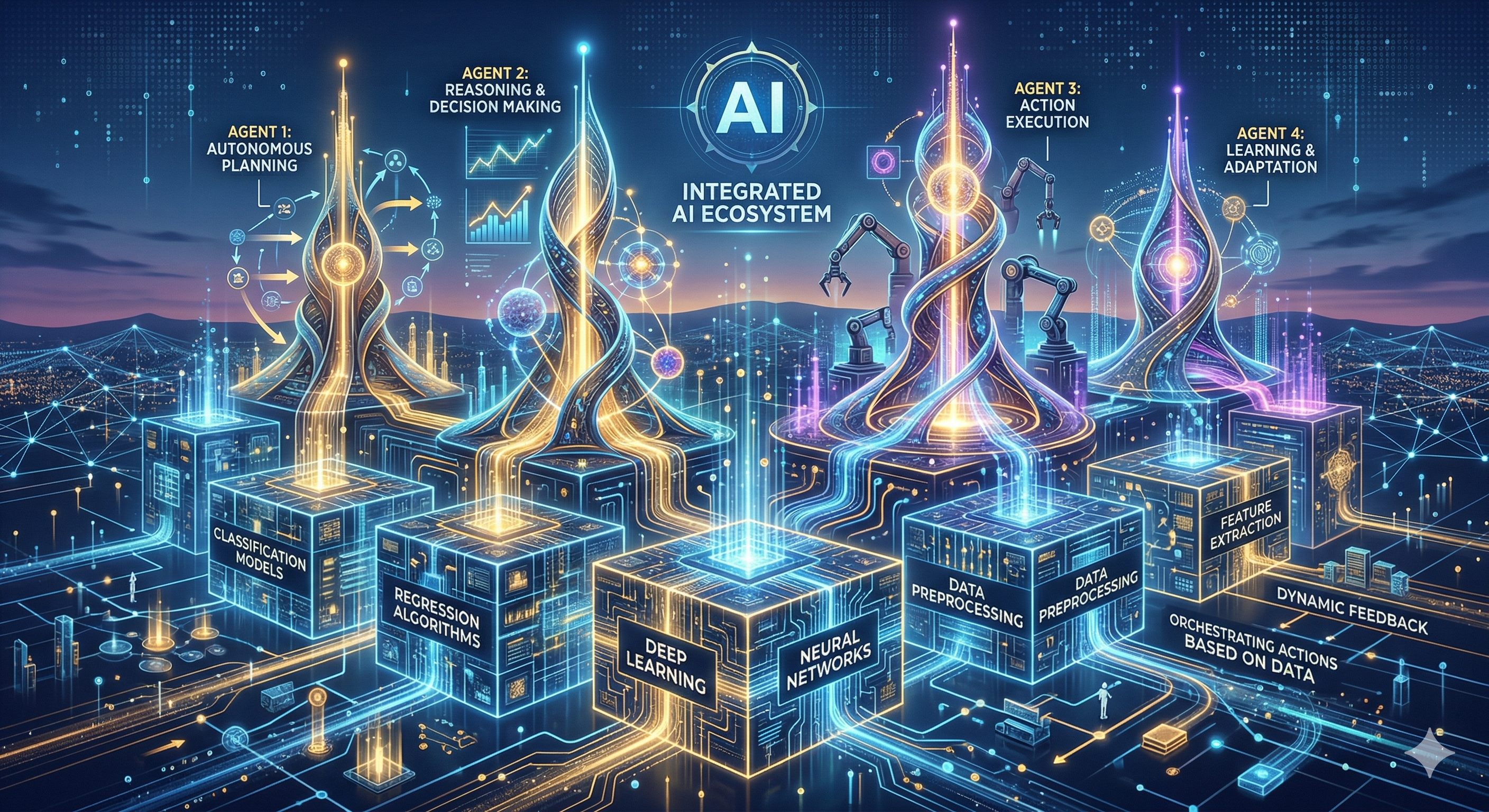
In this architecture, the AI Agent is the General Contractor. It sees the whole picture, understands the goal (e.g., “Build a supply chain”), and creates a strategy. The Agent is great at logic, context, and language, but it doesn’t do the precise, specialized calculations itself.
Traditional Machine Learning (TML) models are the master specialists—the electricians, the plumbers, and the structural engineers. When the Contractor needs to know the load-bearing capacity of a beam or how much piping to order, they don’t guess. They call the specialist.
Traditional ML is a white-box system optimized for one thing: mathematical precision on structured data. These models are stable, predictable, and incredibly efficient.
The Anatomy of an Agent’s Decision
If an AI Agent is the “brain,” traditional ML provides the critical, verifiable “facts” that allow the brain to make sound decisions. An Agent doesn’t create data out of thin air; it leverages external knowledge and external tools.
This is where the distinction becomes crucial. Many people confuse the capabilities, assuming the Agent can simply “reason” its way through every data type.
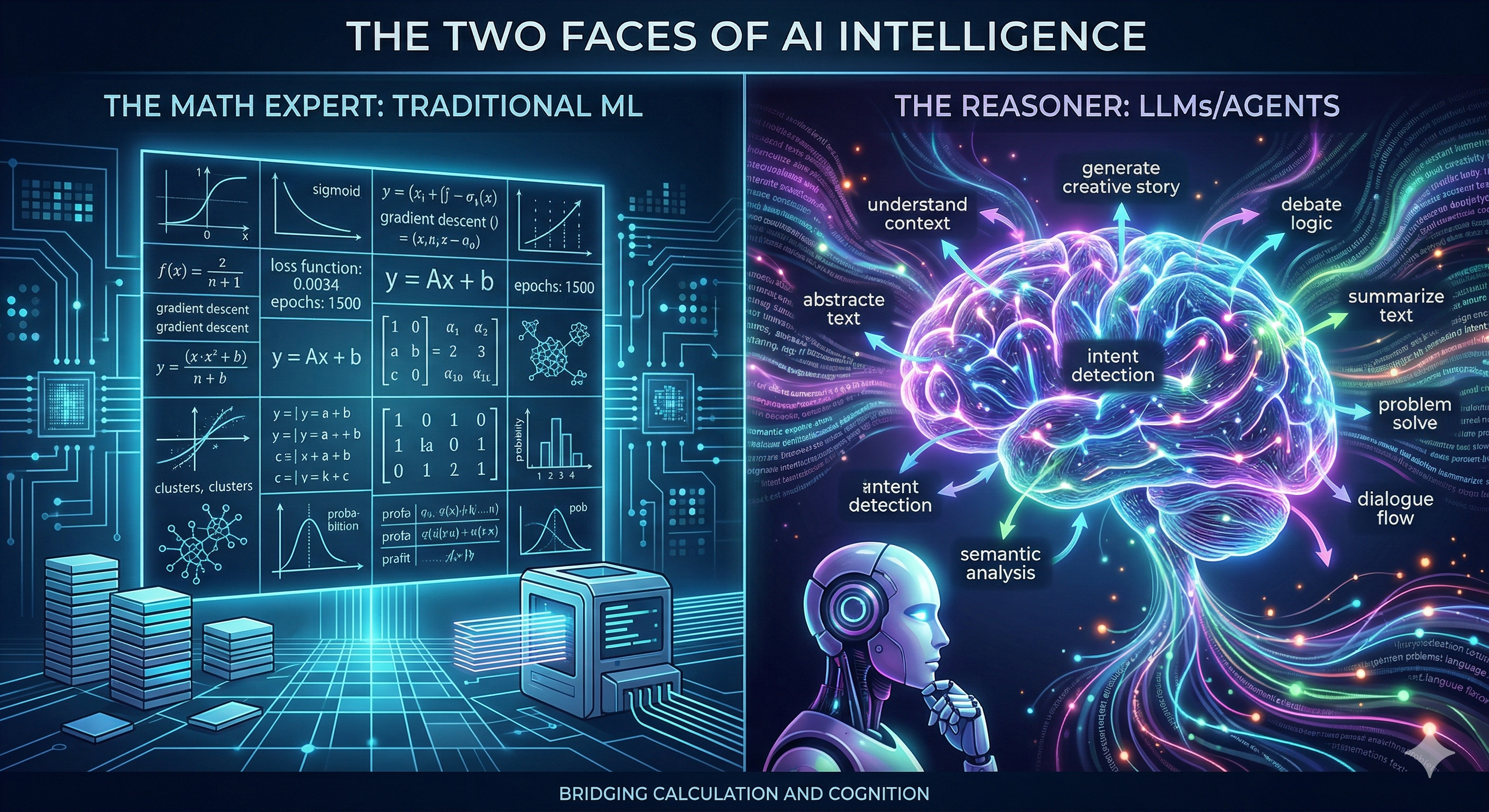
This split highlights the core difference:
- Traditional ML: Reigns supreme in the world of Structured Data (spreadsheets, SQL databases). When you need to find a pattern or a precise numerical prediction (regression/forecasting) in millions of rows, these mathematical specialists are unbeatable.
- LLMs & Agents: Dominate the world of Reasoning, Language, and Context (Unstructured Data: text, conversation). An LLM is a phenomenal communicator, but it cannot “calculate” a complex forecast with the same rigorous accuracy as a dedicated time-series model. It is probabilistic, not deterministic.
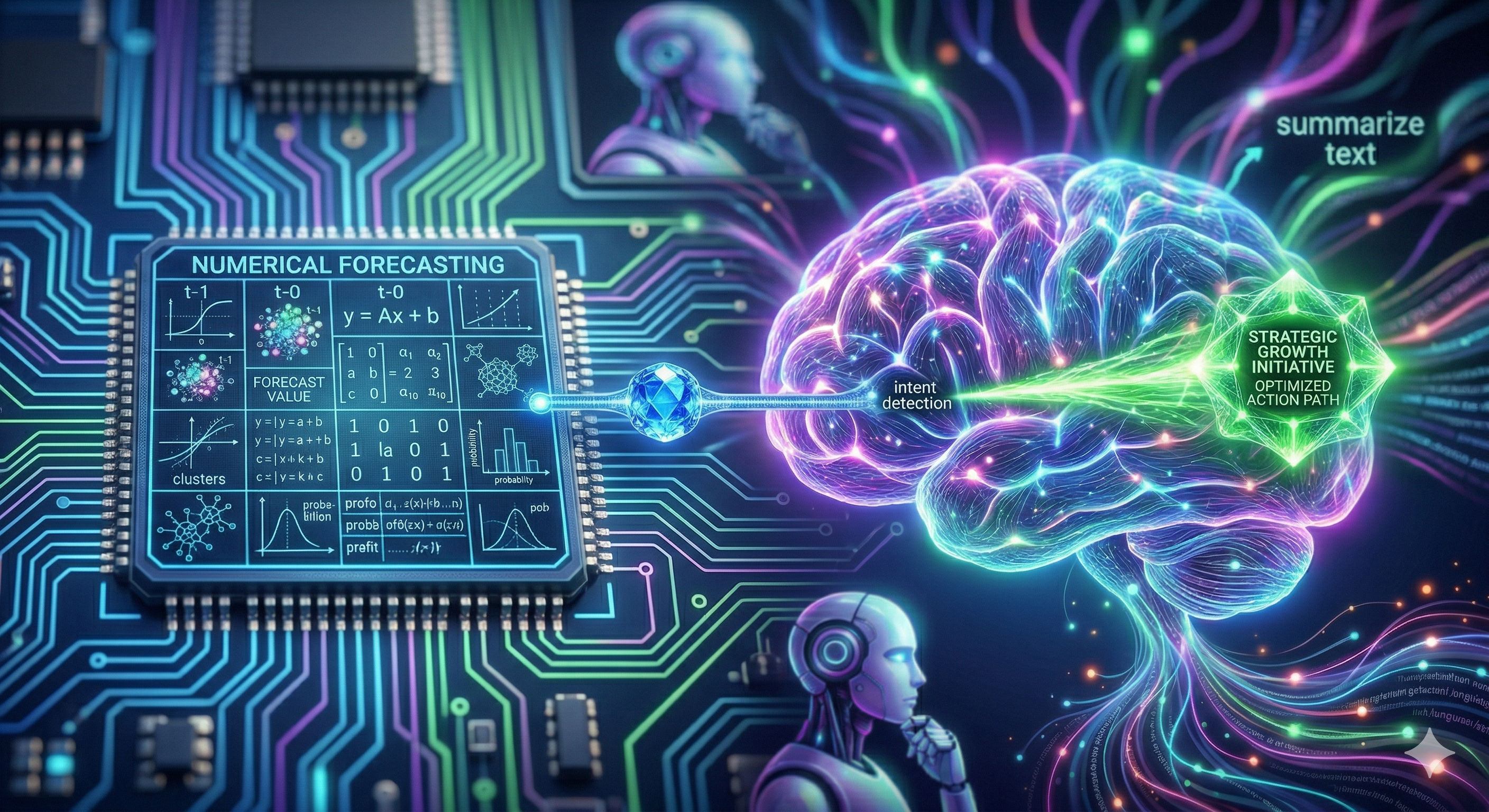
This diagram shows how they connect: The Agent uses Traditional ML as a high-precision sensor, feeding specific data points into its reasoning process to make a better final decision.
Why Enterprises Stick with the “Boring” Math
The trend in 2026 is “Agentic Workflows” rather than “Agent Replacement.” The reasoning isn’t just theoretical; it’s operational. Here are three critical reasons why enterprises must retain traditional ML.
1. Structured Data Dominance
Most of an enterprise’s critical information—financial logs, inventory counts, transaction history—is structured. TML models are mathematically tuned to find relationships in these tables that LLMs struggle to “see.” An agent can summarize a table, but a random forest model can optimize it.
2. Cost and Latency
Running an LLM through multiple “reasoning loops” to make a simple decision (like “is this email spam?”) is massively expensive. It also takes several seconds (high latency). A traditional, binary classifier can make that same decision in milliseconds for a fraction of a cent. At scale, the economic difference is staggering.
3. Interpretability and Compliance
Many industries (Healthcare, Banking) must explain their decisions.
- Traditional ML is a “Glass Box”: An engineer can point to the specific data features that drove a Decision Tree’s outcome (e.g., “rejected because the credit score was below 600”).
- AI Agents are “Black Boxes”: It is legally risky to base a critical decision (like a loan approval) on the opaque reasoning of a probabilistic language model, which can hallucinate or change its logic.
Conclusion: Hire a Team, Not just a Genius
If your problem is “What will the exact number be?”—use Traditional ML.
If your problem is “I need to handle a multi-step process that involves language.”—use an Agent.
The future isn’t about choosing one or the other. If you have legacy ML models that work, keep them. Give those specialists a manager. Building a powerful AI strategy in 2026 means building a team where the Math Experts and the Reasoning Engines are perfectly integrated.
Key Takeaway: Traditional ML isn’t a dying art; it’s the specialized infrastructure that makes advanced AI possible.
Credits
- Image credits: https://gemini.google.com/